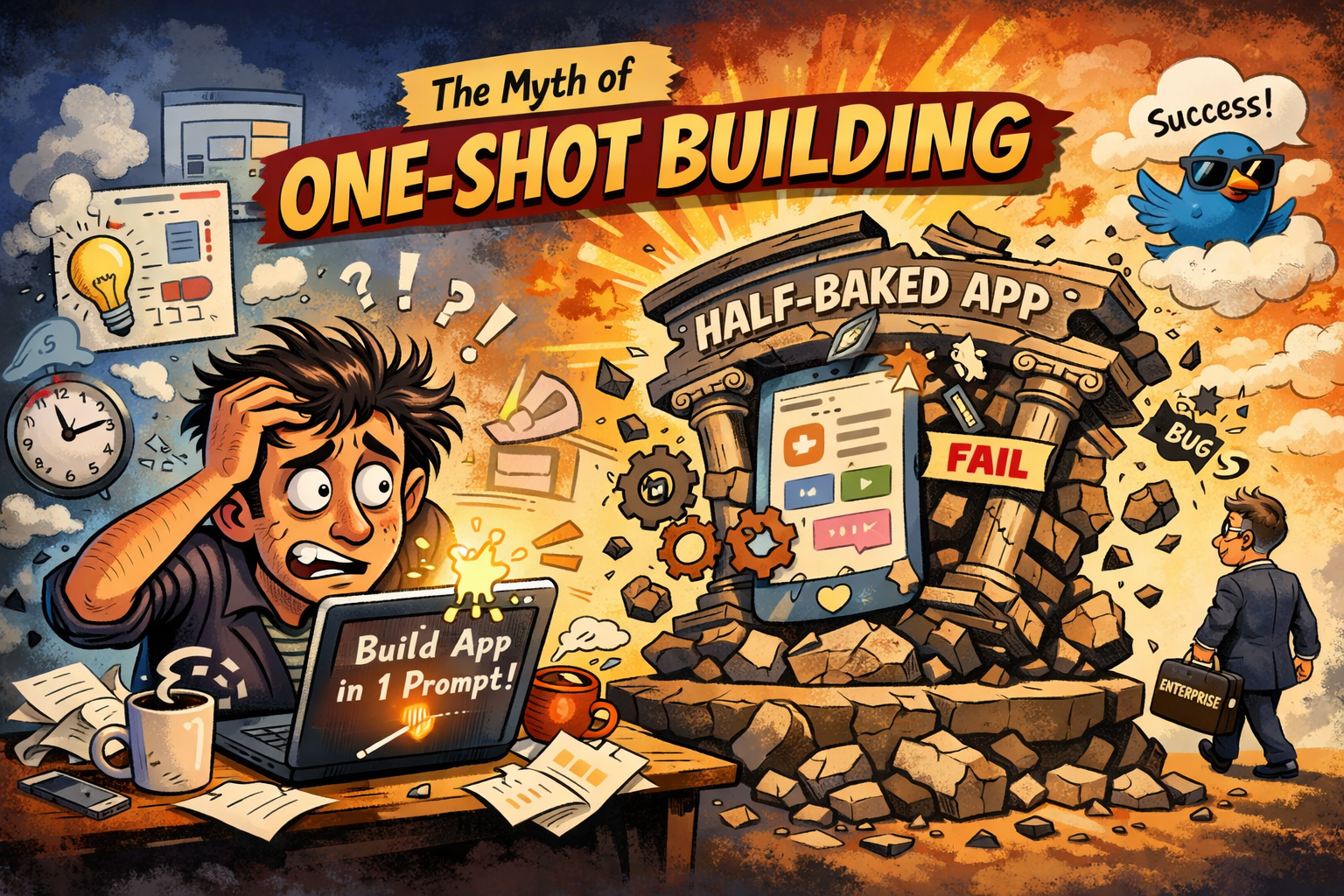
The Myth of One-Shot Builds
Social media suggests vibe coding is like instant noodles. Is it really?
Contrary to popular belief, truly build-worthy ideas are rare. What fills our timelines today are fragments of intent. Half-formed concepts dressed up as products.
Vibe coding platforms have amplified this illusion. Tools like Lovable and Bolt promise creation at the speed of thought. And they do help you get started. You can generate UI, wire up flows, even simulate something usable. But that first burst is the easy part.
Most projects never move past it.
Not because the tools fail, but because the ideas lack depth. A real product needs structure, edge cases, trade-offs, and a path to execution. Without that, even the best tools stall out.
The bigger myth is that building is a one-shot act. Social media suggests a single prompt can produce something meaningful. In reality, it produces a starting point. Everything after that takes patience, clarity, and sustained effort.
This is where people drop off. Not from lack of tools, but from lack of conviction. Turning an idea into something usable means thinking through flows, handling failures, refining the experience, and figuring out distribution. None of this is instant.
There is also the question of bandwidth. Unless building is part of your job, it is hard to sustain. Even with AI, you still need to understand concepts, make decisions, and debug. Add deployment and marketing, and most ideas quietly die.
Modern tools do not remove effort. They compress the start, not the finish.
That gap shows up as churn. Users arrive excited, build halfway, then leave when the novelty fades. The issue is not access. It is the absence of real outcomes.
Over time, these platforms will have to evolve. Hobbyist energy is not a business model. To survive, they will need to serve enterprise needs where reliability, integration, and measurable outcomes matter.
The current wave is not replacing builders. It is exposing what building actually requires.
And it has never been a one-shot process.
— Nehal