Notes from an AI + Hardware Buildathon
Notes from an AI + hardware buildathon on why young makers in India need an ecosystem beyond the first working demo.
Before Covid, I used to tinker with Arduino boards, Raspberry Pi, sensors and robotics components with colleagues at the maker studio we had set up inside our office. Then work-from-home started, my role changed, and that part of life slowly disappeared.
So when I read about an AI + hardware buildathon, the child in me couldn’t resist the urge to sign up! An event where an 8yo child was building in the same room as university students, engineers, experienced hardware professionals, and hobbyists like me.
What I saw there made one thing clear: AI has moved the starting line for young makers.
Earlier, if we were making something with Arduino, Raspberry Pi or sensors, we would spend weekends reading documentation, searching forums, figuring out configurations and writing code. Today, with tools like Codex or Claude, a program that took a couple of weekends can often be written in minutes. This shifts the focus from engineering to design.
That makes first working version, a prototype, much faster to build and demonstrate.
It is no longer just:
Can I build this?
It becomes:
Who needs this, and can I make it work for them?
Our team worked on a problem from chess.
In local clubs and small tournaments, most board-based chess games are not digitised. Young players and students who cannot afford expensive connected tournament boards often miss out on computer analysis after the game.
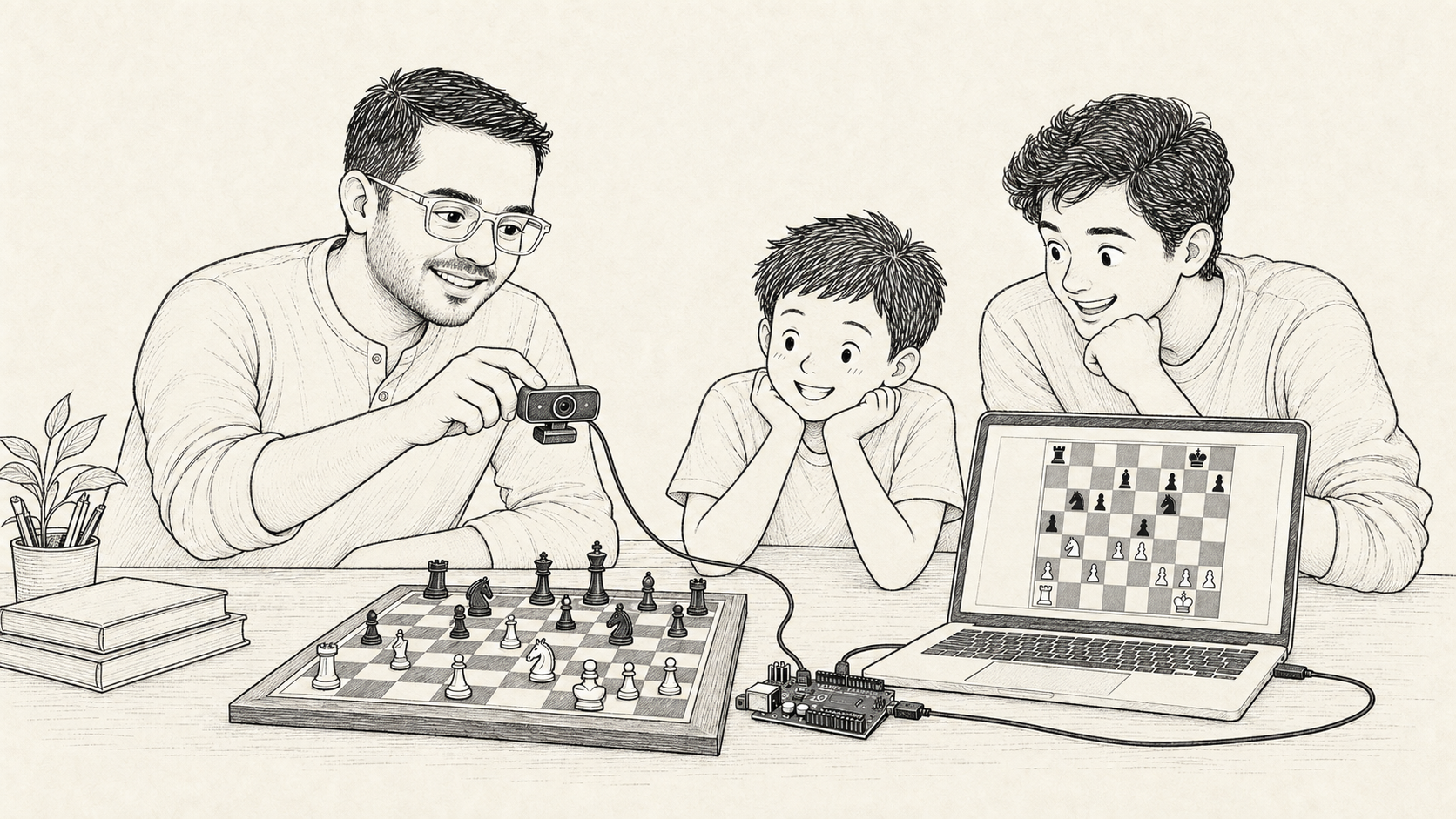
We picked the computer vision theme and were given a webcam, Arduino Uno Q, and some breadboard and wires. We mounted a webcam above a regular chess board. A computer-vision model running on an Arduino Uno Q captured the pieces and converted the position into a digital board PGN. Stockfish analysed it, and the system could explain the analysis in natural language (English or Hindi) using the local LLM.
All of this worked from the device, without an active internet connection.
The demo came together in a few hours. But making it useful for a school or a chess club is a very different problem. Different boards, lighting, camera angles, piece designs, children moving pieces casually, someone bumping the table, a coach setting it up without knowing the code.
That is where most hardware ideas become real or collapse.
The project that won the buildathon was about miners working in deep mines. The team, that included 8yo Lakshveer, built a prototype that sensed changes in pressure, moisture and related conditions, then made decisions for emergency response in situations like gas leaks or water flooding.
Another team used a webcam to detect fruits and vegetables, and estimate nutrition based on weight measured through a laptop trackpad.
None of these were polished products. What mattered was that most teams were solving problems they had personally experienced or observed closely. That proximity is a real strength in India.
Someone who has played in a small chess club understands why an expensive digital board is out of reach for most young players. Someone who has seen mining risk understands why a warning system has to work in rough conditions. Someone who has watched a family member struggle with a phone understands access differently from someone reading a market report.
This is the instinct young learners need to develop.
India already has serious public infrastructure for tinkering. Atal Innovation Mission reports 10,000 Atal Tinkering Labs and more than 1.1 crore students actively engaged in them. A PIB backgrounder from December 2025 says ATLs have led to more than 16 lakh innovation projects, with 50,000 more labs in roll-out for 2025-26. That scale matters.
But a lab by itself does not create a maker culture. A kit can remain locked in a cupboard. A hackathon can produce a good demo and still leave the child with nowhere to go the following week.
Most hackathon projects stop at the demo. That is understandable. Hackathons are designed for speed, excitement and showability. They answer the “can we make it work once?” question.
What young makers need is the next room after the demo.
A place to return to. Tools they can use again. Mentors who can say, “try changing the sensor angle”, “your enclosure will fail here”, “go back and watch the user again”, “reduce one feature”, “make it cheaper”, “test it without explaining it”.
Inexpensive components help people start. Shared workshops help them build better prototypes. Small grants reduce hesitation. But access to real users tells them whether the problem matters, and mentors tell them what it would take to make the product reliable, repairable and affordable.
This is especially true in education.
Children use hardware very differently from adults. Parts break. Wires come loose. The activity has to work within a 35-45 minute classroom period. Teachers need enough training to guide the session without being expected to become robotics engineers overnight.
Many schools keep making and robotics as optional after-school activities because integrating them into the timetable is difficult. Teachers are already working inside syllabus pressure, exam pressure, crowded classrooms and limited time.
A 2021 review of educational robotics teacher training found that half the programs studied had no completion requirement beyond attendance, and many were very short. The authors recommended longer training, classroom practice, proper teaching methods and teacher networks that continue after the training ends.
That is the missing bridge.
A real maker ecosystem would connect school students, college students, engineers, designers, teachers and hobbyists. It would connect students to schools, clinics, farms, homes, mines, clubs, local shops and small businesses. It would make it normal for a child to build something rough, show it to a real user, watch it fail, and come back with a better version.
AI makes this more urgent.
If coding becomes easier, children need more practice deciding what is worth building. If devices can listen, see, classify and respond, children need more exposure to the messy environments where those devices will be used. If a rough demo can be made in six hours, then the educational value shifts to what happens after those six hours.
I do not want every child to become a hardware engineer. That would be a strange goal. I want more children to become comfortable with the physical and digital systems around them. To see technology as something they can examine, modify, question and build with.
The useful test is simple: does the hardware sense something important, reduce friction, and help the user take action?
For a young maker, the deeper question is even better:
Whose life is harder because this problem exists, and can I keep working on it after the first demo?
— Nehal