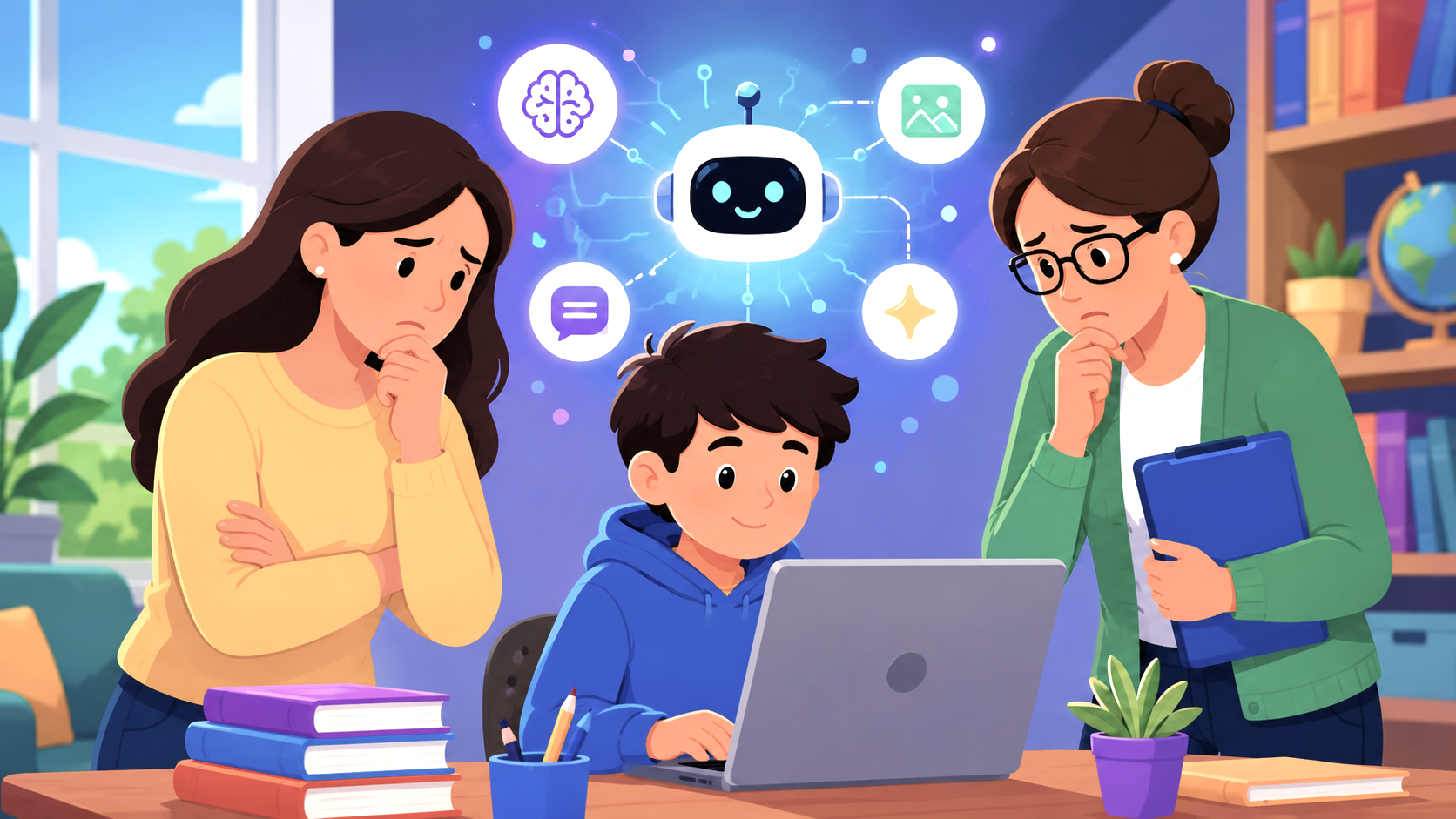
Should kids do AI? Wrong question.
Banning AI from classrooms feels like the responsible move. But the real risk isn't access. It's the wrong relationship with it.
When I was doing research for Lernok, I spoke to dozens of parents and teachers across the globe. The same things kept coming up.
“AI is not allowed at our school.”
“We’ve restricted internet access in classrooms.”
“We caught students submitting ChatGPT-written essays as their own work.”
I understand the impulse. When a child types “write me a 500-word essay on the water cycle” into ChatGPT and submits it the next morning, banning the tool feels like the only logical response.
But here’s the question worth sitting with. Does closing the door make your child safer? Or does it just mean they’re using it anyway, outside your field of vision, with no one there to shape how?
Because even in schools that have banned AI, kids are talking about it. They’re sharing image generation prompts, watching YouTube videos about it, hearing about it from friends. The curiosity is already there. Banning access doesn’t remove it. It just removes the guidance.
The concern is valid. It’s pointing at the wrong thing.
A child who used to struggle through a textbook to find an answer now types the question and gets three clean paragraphs in seconds. A student supposed to work through a maths problem is asking AI to solve it step by step, then copying the method without understanding it.
The worry underneath all of it is this: if AI does the thinking, the child stops thinking.
That worry is not wrong. It’s just incomplete. The real problem isn’t that kids are using AI. It’s that most of them are using it as consumers, not creators. And nobody is showing them the difference.
What the research actually found
A 2025 study by Michael Gerlich found that adults over 46 showed higher critical thinking scores even when using AI regularly. Those aged 17 to 25 showed the opposite: the more they relied on AI, the weaker their analytical skills. The difference isn’t intelligence. Adults already had the foundation built. Researchers call what happens to them cognitive atrophy: skills weaken from disuse, but the capacity remains.
Children face a different problem. Researchers call it cognitive foreclosure. If a child outsources thinking before the underlying skill develops, the skill doesn’t weaken. It never forms. There is no baseline to return to. (Gerlich, 2025; Shen and Tamkin, 2026)
Banning AI doesn’t solve this.
The consumer trap
AI amplifies what you bring to it. A skilled, agentic person gets dramatically better. A person with weak foundations gets worse, because they hand over judgment to a tool that has none.
Unguided AI use teaches kids one thing: AI is the answer. Type in a question, get a result, move on. “AI can do it, so I don’t need to” becomes the default. That assumption is exactly what makes a child replaceable.
The shift that matters is from consumer to creator.
A consumer asks ChatGPT to write their essay. A creator uses AI to validate an argument they’ve already formed.
Same tools. Completely different relationship with them.
A different frame for teachers
Teachers ban AI not out of stubbornness but out of self-preservation. No training, no policy, 40 students waiting. That’s the reality in most schools in India and the US alike.
But there is a different way to think about AI in a classroom. Not as a tutor. As a co-facilitator.
A co-facilitator creates more space for the teacher’s judgment, not less. The teacher who says “use AI to research the economic recession of 2008” is handing over their job. The teacher who says “use AI to write a newspaper front page from 1857, and explain every editorial decision you made” is using AI to demand more thinking.
A different frame for parents
The deepest fear parents hold isn’t cheating. It’s dependency.
We don’t keep kids off the internet because they might become dependent on Google. We teach information literacy. AI is the same challenge.
Think of AI as your child’s coworker. Highly capable, never tired, never judgmental. The question is whether they know how to direct it, push back on it, and own the outcome. That’s the skill. Not avoidance. Intelligent use.
Three things to do this week
For teachers: Replace one assignment this term. Not “research this topic using AI” but “use AI to build something about this topic.” A game, a tool, a prototype. Something that required a decision, a mistake, and a revision.
For parents: Change the question at the end of the day. Not “did you finish your homework?” but “what did you make today?” The habit of making builds a completely different relationship with AI than the habit of consuming.
For both: Use an AI tool together with your child. Ask it something neither of you knows. Push back on the answer. Check whether it’s right. You don’t need to be the expert in the room. You just need to be in the room.
The door is already open
Teenagers in Mumbai and Bengaluru are using ChatGPT the same way teenagers in New York and London are. Some are building with it. Most are consuming it. The question of whether they’ll have access was settled the moment smartphones became affordable.
The question that remains is whether someone shows them the difference between a user and a creator, between a prompt and a decision, between a tool and a crutch.
That someone can be you.
— Nehal