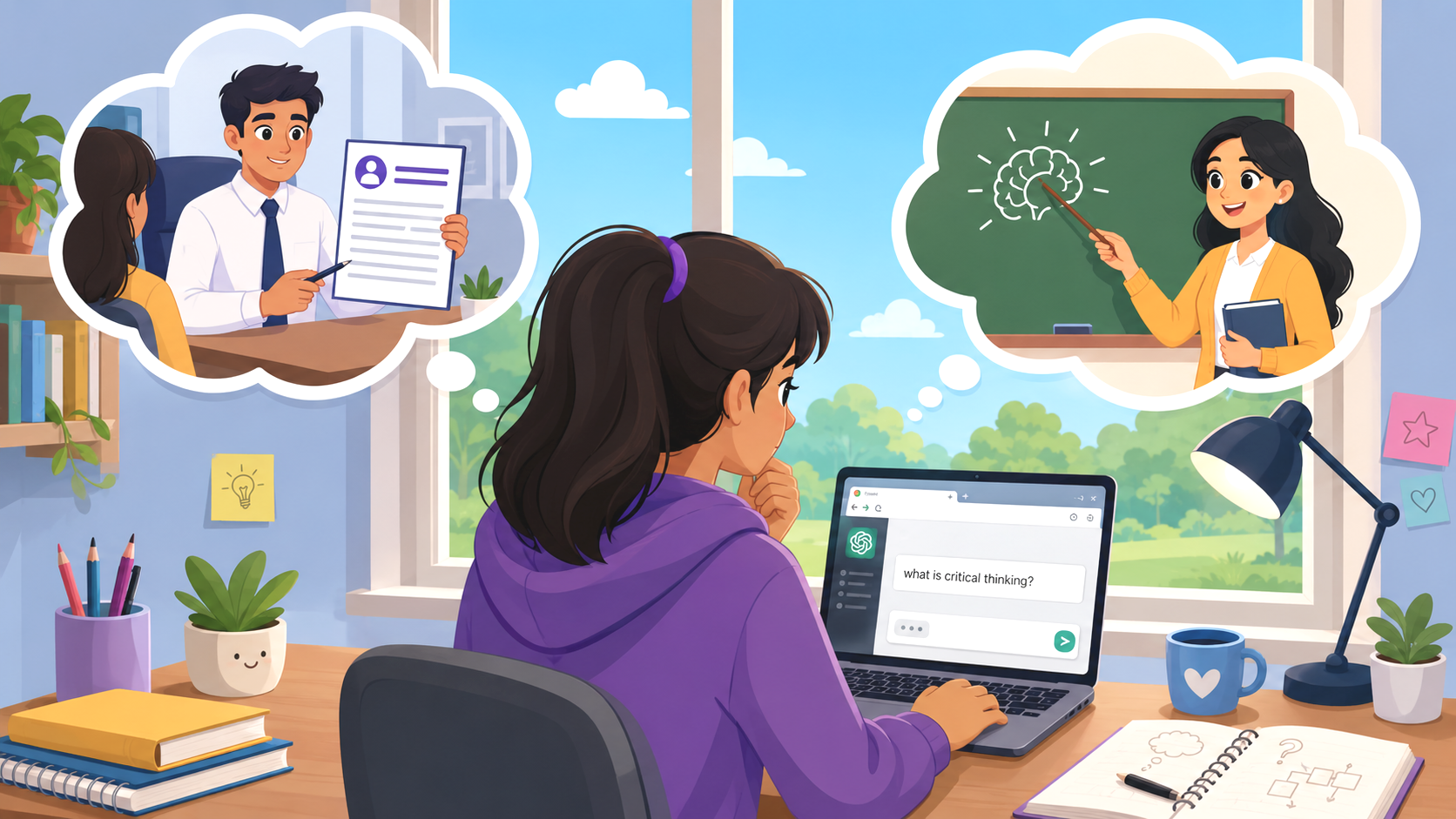
The Curious Case of Critical Thinking
Schools talk about critical thinking constantly. They almost never teach it. With AI changing everything, this gap has become urgent.
Last week, I published an article asking whether kids should have access to AI. One of my peers, a well-respected figure in tech education with decades in the field, left a comment that struck a chord with me.
“I think more than AI itself, what all kids need to learn are first principles thinking, problem solving and the ability to express themselves clearly. I meet learners who are at the last leg of their college and I find the above skills missing due to which they fail everywhere and it is too late by that time. AI too demands these skills.”
The comment not only resonated deeply with me but got me thinking about how widespread this gap in foundational skills really is, as I have been hearing the exact same thing from both school and industry leaders alike, for years. By the time the gap in foundational thinking becomes visible, it is too late to close it.
That comment is why I am writing this piece.
The word is everywhere. The practice is almost nowhere.
Ask any school principal what their institution teaches and critical thinking will appear in the first sentence. It is in every brochure and prominently featured in NEP 2020, along with higher-order thinking and competency-based learning.
It is also one of the famous 4Cs of 21st century skills alongside Communication, Collaboration, and Creativity. Everyone agrees it matters. Yet walk into most classrooms and you will see teachers racing through content, students copying notes, and tests that reward memorisation and recall. The mission statement promises critical thinking. The daily reality does not.
The definition problem
Critical thinking is not forming opinions, group discussions, or asking random questions.
It is the ability to analyse information, spot underlying assumptions, evaluate evidence, and reach reasoned conclusions when the answer is unclear and data is incomplete.
This specific skill must be built deliberately. Yet surveys show most faculty cannot clearly describe which critical thinking skills they are actually teaching, even while calling it a top priority. That gap in clarity flows straight into classrooms.
What passes for critical thinking usually is not
Schools highlight debates, group discussions, case studies, and open essays. These create conversation and opinions, but rarely build the cognitive muscle of evaluating evidence and testing arguments.
The activity feels like critical thinking. The real skill is cognitive, not social. This confusion is why the gap persists.
Teachers want to teach it, but the system works against them. Every minute on deep reasoning is a minute not covering the syllabus. Exams too, especially India’s competitive entrance tests, reward speed and pattern recognition over careful thinking.
NEP 2020 says the right things on paper. The ground reality is different. Most schools lack the training and redesigned assessments to make it happen. Culturally too, a “good” student is one with high marks, not one who pauses to think.
AI has made this urgent
Before AI, weak reasoning still forced some thinking. Now every question has an instant answer and every essay has a ready draft. Adults who over-rely on AI experience cognitive atrophy. Skills weaken from disuse, but the underlying capacity remains. Children face something worse. Without built-in critical thinking, they can coast without ever developing the skill. Researchers call this cognitive foreclosure: pathways for reasoning that never form.
But AI does not have to be the enemy. A recent X post by Andrej Karpathy (prominent AI researcher, he joined Anthropic while I was writing this article) comes to mind:
“Drafted a blog post
- Used an LLM to meticulously improve the argument over 4 hours.
- Wow, feeling great, it’s so convincing!
- Fun idea let’s ask it to argue the opposite.
- LLM demolishes the entire argument and convinces me that the opposite is in fact true.
- lol
The LLMs may elicit an opinion when asked but are extremely competent in arguing almost any direction. This is actually super useful as a tool for forming your own opinions, just make sure to ask different directions and be careful with the sycophancy.”
What Karpathy did was use AI as a reasoning partner: “Does this argument hold up? What am I missing? What would the opposing view say?” Try this and watch your regular ChatGPT or Claude become one of the best tools to practise the 4Cs, especially critical thinking.
AI demands these skills. It amplifies what you bring to it. The question is what we are teaching them to bring.
What actually develops critical thinking
It grows through consistent Socratic questioning, problem-based learning where students justify their answers, and projects that treat being wrong as part of the process.
I tested Socratic questioning and ‘why’ ladders in a pilot cohort at Lernok last year. The results were astonishing. The kids learned to break down a problem to its most basic form, essentially ‘first-principles’ thinking.
Takeaway: Critical thinking cannot be a separate subject. It must be the method through which every subject is taught.
What you can do this week
Parents: Shift one question. Instead of “What did you learn?” ask “What did you figure out today?” When they use AI, ask: “What did it say? Do you agree? How would you check?”
Teachers: End every lesson with: Not “Does everyone understand?” But “How do you know that’s true?”
The skill that makes every other skill work
Critical thinking is not just one of the 4Cs. It is the foundation that makes Communication, Collaboration, and Creativity actually effective. Without it, coding becomes brittle, AI use becomes blind acceptance, and ideas stay shallow.
That comment was right: by the end of college, it is often too late. The window is now: at dinner tables, in classrooms, and in the questions we ask today.
The good news? Real change does not need a new policy. It only needs one question asked differently, starting right now.
— Nehal