Teaching AI: Notes From A Classroom
What a session with 9 to 14 year olds revealed about thinking before you ask, and why that habit matters more than any AI skill.
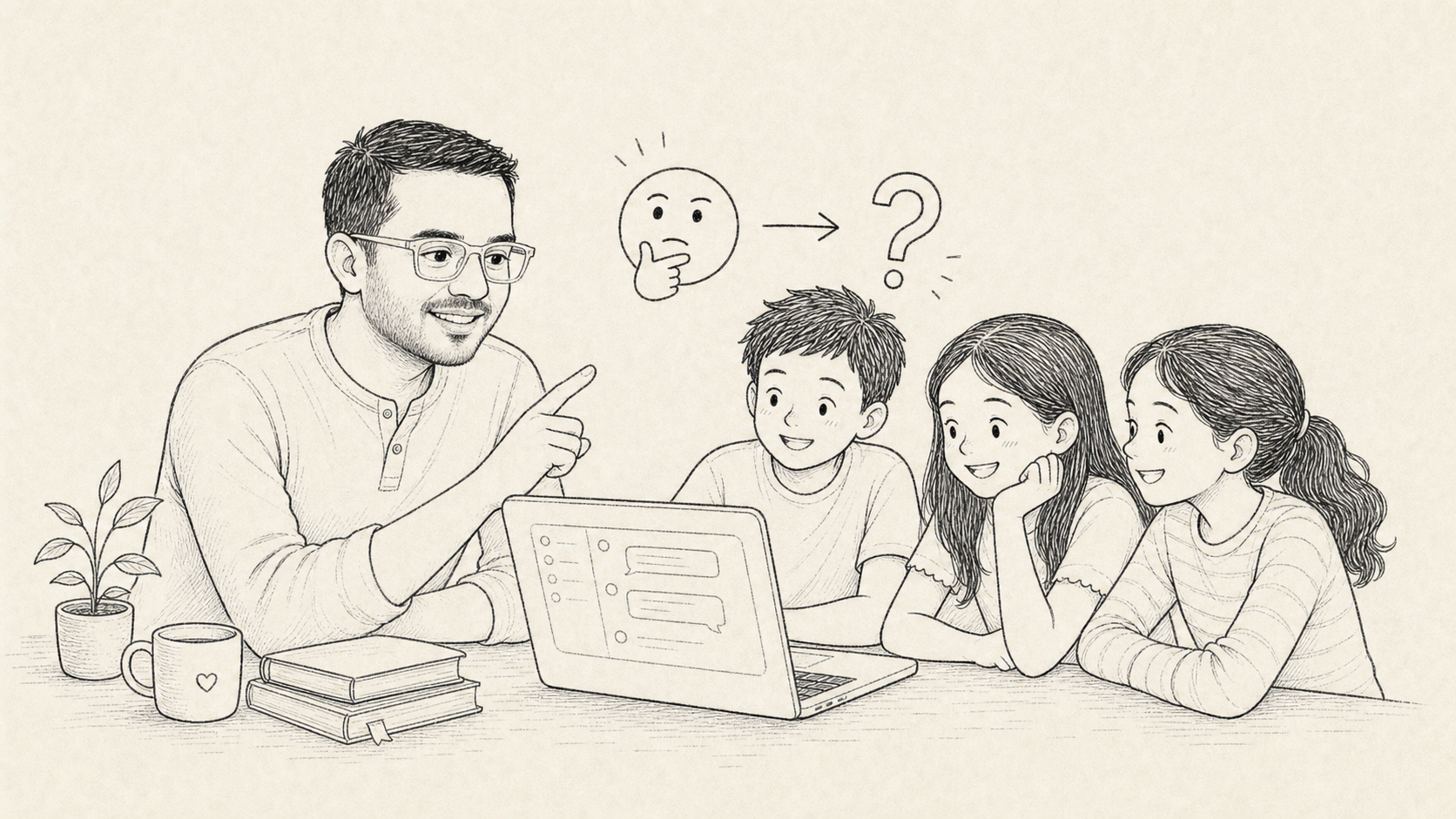
Lernok’s pilot cohort is underway on our AI-native learning platform. I am working with a batch of 9 to 14 year old kids, introducing them to AI tools. Before I let them open ChatGPT, I asked them: how would you differentiate between what to ask Google and what to ask AI?
They looked at me like the answer was obvious. But when I pressed them to explain they all struggled.
The difference is, if it’s a query then ask Google. And if it’s a well formed question or instruction, only then ask AI. For example, “pizza near me” is a query, “how to make a pizza?” is a question.
A query is what you type when you want options, directions, or somewhere to start. A question is when you need a specific answer, not a list of possibilities. Google is good at queries. AI is better at questions, but the quality of what it gives you depends entirely on how well-formed the question or the ask is.
Most of us (kids and adults) use AI like a glorified search engine. We type something vague and hope it does what we meant. It usually does. And that convenience means we never have to think clearly before we ask. The problem is the quality of what comes back is decided before you type. If you don’t know what you want, neither does the AI. You get something polished and general, or three clarifying questions bounced back at you.
Both are a sign that the thinking didn’t happen first.
Later in the same session, I asked them to think of a question they could ask ChatGPT that would give it away as an AI, not a human. One of the kids said, “just ask it.” Fair enough. But what if it is trained to hide it?
Over the next few minutes they moved from “ask it about preferences” to “but it’s trained on human data, so maybe it fakes that” to “does it eat? does it sleep? what does it think about when it can’t sleep? can we ask what’s your favorite color or smell?”
They got somewhere real. Not because I led them there, but because I didn’t.
What they discovered, slowly and on their own, is that AI has no body. No hunger, no morning, no smell. The things that define a human person, the physical experience of being alive, are exactly what AI has none of.
That is not a trivial observation. Researchers have been formalising it for years, arguing that the original Turing test only measures language, not intelligence in the fuller sense.
That exercise was not about AI. It was about thinking. These kids were doing first principles reasoning in real time, without me naming it. They were more confident at the end of that session than at the start.
My message to the kids at the end of the session was:
If given 10 hours to cut a tree, spend 8 hours in sharpening your axe. 🪓🪵
This is what I mean by thinking before you ask.
When you use AI without doing the thinking first, the output belongs to the AI, not you. You become a reviewer of its ideas. The role reversal is easy to miss.
Frequent AI use correlates with measurable decline in critical thinking, especially in younger users (Microsoft/CMU 2025).
MIT researchers called it “cognitive debt”: deferring mental effort has consequences that show up later in adult life.
If kids pick up AI before they’ve built the habit of thinking through problems, they won’t just skip it, they’ll never form it. I wrote about cognitive foreclosure in an earlier piece. This is where it matters most.
I think about this while building Lernok. The temptation is always to design for the quick answer, the smooth session, quick wins, the instant feedback loop. But if I build something that teaches kids to reach for AI before they’ve formed a question, I’ve made the problem worse.
Thinking is the only part of this that AI cannot do for you. Not because AI is bad at it, but because if AI does your thinking, the output belongs to the AI, not to you. You become a reviewer of its ideas, not a thinker.
What I want for the kids coming through Lernok is not that they get good at using AI. I want them to develop the habit of forming a question before they open it. If they can do that consistently, the tool becomes theirs to use rather than something that uses them.
— Nehal